


Ethiopia coffee occupies a unique position in the coffee world. Ethiopia is the native home of Coffea arabica and contains extraordinary genetic diversity that has helped shape coffee cultivation around the globe.
Yet Ethiopian coffee isn’t defined by history alone.
From the floral and citrus characteristics associated with some Yirgacheffe coffees to the fruitier profiles found in natural-processed lots, Ethiopia produces an enormous spectrum of flavours.
This Ethiopia coffee guide explores its origins, famous growing regions, diverse Arabica coffees, processing methods, flavour profiles and some of the best ways to brew Ethiopian beans at home.
The birthplace of Arabica coffee
Ethiopia is widely recognised as the native home of Coffea arabica.
World Coffee Research states that Arabica is native to Ethiopia, where the species’ greatest genetic diversity is found.
Coffee plants growing in Ethiopia provided the genetic foundation from which Arabica eventually spread around the world.
Historians believe coffee seeds travelled from the forests of southwestern Ethiopia to Yemen, where coffee was cultivated as an agricultural crop. Descendants of those plants eventually spread much further, forming the foundation of most Arabica cultivation outside Ethiopia.
You can learn more about this history through World Coffee Research’s guide to the history of Arabica.
That makes Ethiopia coffee particularly fascinating: you’re drinking coffee from the part of the world where the Arabica species originated.
The legend of Kaldi and his goats
No discussion of Ethiopian coffee history would be complete without Kaldi.
According to the famous legend, an Ethiopian goat herder named Kaldi noticed that his goats became unusually energetic after eating red berries from a particular plant.
Kaldi supposedly tried the fruit himself and discovered its stimulating effects.
Different versions of the story then describe monks using the berries or a drink made from them to remain alert during prayer.
It’s an entertaining story, but it shouldn’t be presented as established historical fact.
There is no reliable contemporary evidence confirming that Kaldi was the person who discovered coffee. The tale is better understood as part of coffee folklore.
The scientifically important fact is much stronger: Coffea arabica is native to Ethiopia.
Why is Ethiopia so important to coffee?
Most Arabica production outside Ethiopia descends from a relatively narrow selection of genetic material that left the region centuries ago.
Ethiopia is different.
Its coffee populations contain enormous genetic diversity, including locally adapted landraces that developed over generations.
World Coffee Research defines a landrace as a traditional, locally adapted variety that has developed through adaptation to its natural and agricultural environment.
This diversity matters for flavour, agriculture and the future of coffee breeding.
World Coffee Research works with the Ethiopian Institute of Agricultural Research and Jimma Agricultural Research Center to support coffee breeding and research in the country.
This genetic heritage is one of the characteristics that makes Ethiopia coffee unlike almost any other origin.
Where is coffee grown in Ethiopia?
Coffee is produced across several areas of Ethiopia, particularly in the country’s south, southwest and east.
Names commonly encountered on speciality coffee bags include:
- Yirgacheffe
- Sidama
- Guji
- Jimma
- Limu
- Harrar
These names can refer to different geographical and commercial classifications, and Ethiopia’s administrative boundaries and coffee-origin terminology have changed over time.
Individual washing stations, communities and farms can provide much more precise information about a coffee’s origin.
For coffee drinkers, the important point is that Ethiopia coffee isn’t one uniform product. Different areas can produce dramatically different flavour profiles.
Yirgacheffe coffee
Yirgacheffe is one of the most famous names in speciality coffee.
It lies within southern Ethiopia and has become internationally associated with high-quality Arabica.
Washed coffees from the area are particularly celebrated for clean, delicate flavour profiles that can include citrus, florals and tea-like characteristics.
Natural-processed coffees can present a different side of the region, potentially bringing greater fruit intensity and sweetness.
However, Yirgacheffe isn’t a coffee variety.
It’s an origin, and coffees grown there can contain different local Arabica populations.
This distinction is important when understanding Ethiopia coffee because regional names are sometimes mistakenly described as varieties.
Sidama coffee
Sidama is another major Ethiopian coffee origin.
Its varied elevations and microclimates allow the production of a broad range of coffees.
Depending on the specific area and processing method, Sidama coffees can display citrus, floral, fruit, berry, chocolate and sweet characteristics.
The region is large enough that no single tasting profile accurately represents every coffee produced there.
Looking for more precise information about the producer, washing station or local area can therefore be useful when choosing beans.
Guji coffee
Guji has become an increasingly familiar name among speciality coffee drinkers.
Located in southern Ethiopia, it contains highland coffee-growing areas capable of producing distinctive speciality lots.
Both washed and natural coffees are produced.
Depending on processing and origin, Guji coffee can offer combinations of florals, citrus, berries, stone fruit and pronounced sweetness.
For anyone exploring Ethiopia coffee, comparing Guji with Yirgacheffe or Sidama can demonstrate how much diversity exists within the country.
Harrar coffee
Harrar is associated with eastern Ethiopia and has a long-standing reputation in the coffee trade.
The region is particularly known for naturally processed coffees.
Traditional Harrar coffees can offer fruit, berry, spice, chocolate and wine-like characteristics.
The flavour profile can be very different from a clean washed Yirgacheffe.
Harrar is another geographical coffee name rather than a botanical variety.
Recognising the difference between regions and varieties makes it easier to understand the information printed on speciality coffee bags.
Jimma and Limu
Southwestern Ethiopia is another important part of the country’s coffee landscape.
Jimma is closely connected with both coffee production and research. The Jimma Agricultural Research Center was established in 1967 and has released numerous coffee varieties for different Ethiopian growing areas.
Limu is also well known within the coffee trade, particularly for washed Arabica.
Coffees from these areas add further diversity to Ethiopia coffee and reinforce why judging the entire country by one regional profile can be misleading.
Ethiopian coffee varieties and landraces
The word “variety” becomes particularly interesting in Ethiopia.
Coffee drinkers sometimes encounter the term “heirloom” on Ethiopian coffee bags.
It’s a convenient description, but it can oversimplify what is actually an exceptionally diverse collection of coffee populations.
Ethiopia contains many traditional landraces alongside varieties selected and released through formal research programmes.
World Coffee Research notes that the Jimma Agricultural Research Center has released dozens of coffee varieties for different regions and researches quality, diseases, pests and agronomy.
Rather than expecting one standard Ethiopian variety, think of Ethiopia coffee as containing a deep reservoir of Arabica genetic diversity.
If you’d like to learn more about the species itself, read our guide to Arabica coffee beans.
How Ethiopia coffee is grown
Coffee production in Ethiopia takes several forms.
Some coffee grows in forest and semi-forest environments, while other production takes place in gardens or more intensively managed farms.
Smallholder farmers play an especially important role. World Coffee Research estimates that smallholders account for the great majority of Ethiopian coffee production.
Growing conditions differ significantly according to region.
Elevation, rainfall, temperature, shade, soil and local coffee populations all interact to influence the plants and ultimately the cup.
This diversity of environments contributes to the remarkable range associated with Ethiopia coffee.
How Ethiopia coffee is harvested
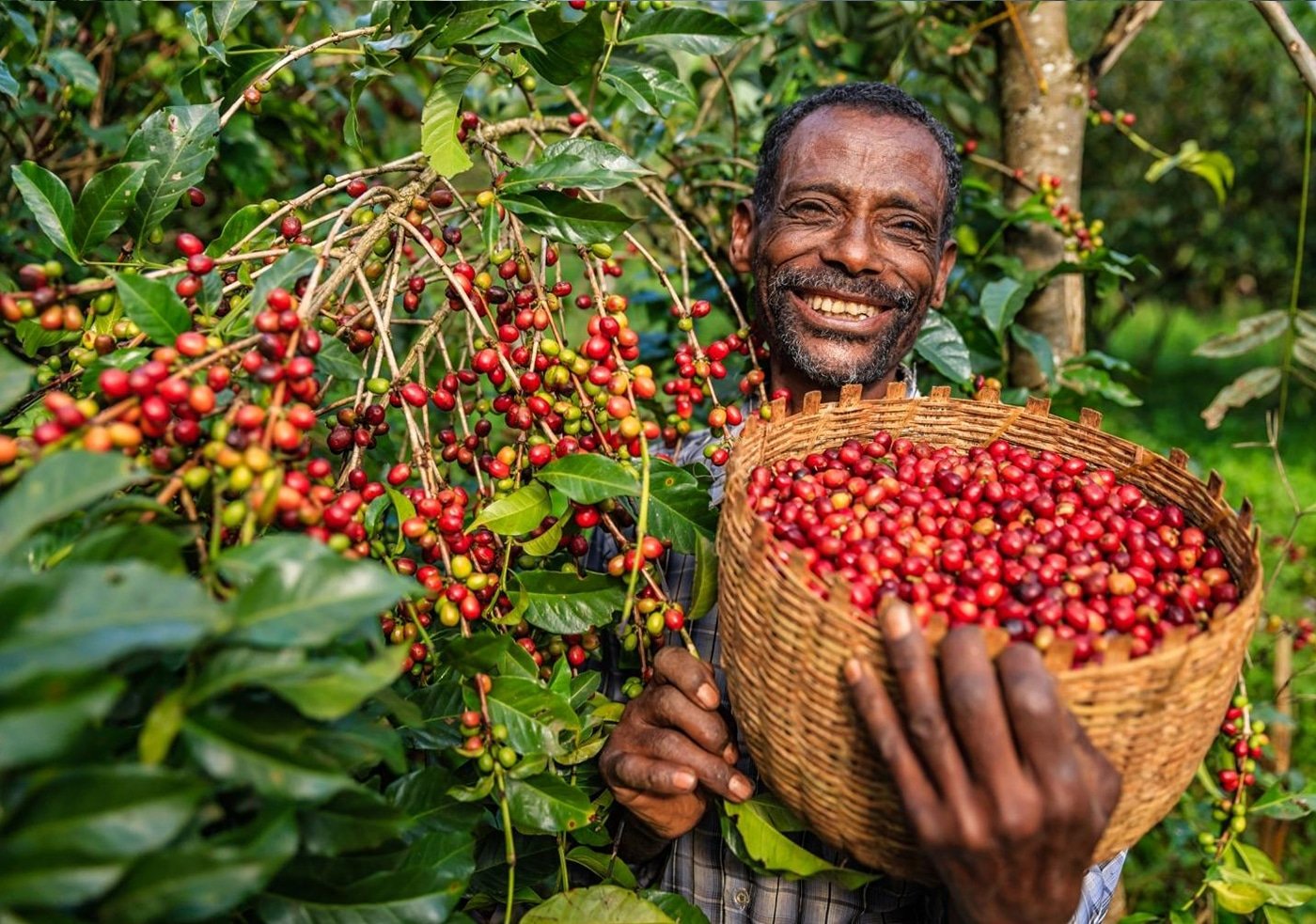
Coffee cherries are generally picked as they ripen.
The exact harvest period varies between regions, elevations and seasons, so it’s better not to assign one rigid harvest window to the entire country.
Selective harvesting of ripe cherries can provide better raw material for quality-focused processing.
After picking, cherries need to be handled and processed carefully.
This next stage is particularly important in Ethiopia because washed and natural processing can produce dramatically different expressions of similar coffees.
Washed Ethiopian coffee
Washed processing removes the coffee fruit before the beans are dried.
After picking, cherries are typically pulped and the remaining mucilage is removed through fermentation and washing before the parchment coffee is dried.
The precise process varies between producers and washing stations.
Washed Ethiopia coffee can display exceptional clarity.
Floral aromas, citrus, tea-like characteristics and bright acidity can become particularly noticeable in suitable coffees.
This style has helped establish origins such as Yirgacheffe among speciality coffee drinkers around the world.
Natural Ethiopian coffee
Natural processing takes a different approach.
Whole coffee cherries are dried with the fruit surrounding the seeds.
Careful drying is essential because poor management can lead to undesirable fermentation or inconsistent results.
When done well, natural processing can create intense sweetness and pronounced fruit characteristics.
Blueberry, strawberry, tropical fruit and wine-like notes are sometimes associated with naturally processed Ethiopian coffees.
The contrast between washed and natural coffees makes processing one of the most interesting aspects of exploring Ethiopia coffee.
What does Ethiopia coffee taste like?
There isn’t one flavour profile that defines every Ethiopian coffee.
Depending on origin, coffee population, processing and roast, you may encounter:
- Jasmine
- Bergamot
- Citrus
- Peach
- Blueberry
- Strawberry
- Tropical fruit
- Black tea
- Chocolate
- Wine-like notes
Washed coffees can be exceptionally clean and floral, while naturals may emphasise sweetness and ripe fruit.
Those are broad tendencies rather than guarantees.
A coffee’s individual tasting notes should always provide a better guide than assuming everything from Ethiopia will taste floral or fruity.
Is Ethiopia coffee good for filter brewing?
Ethiopian coffees are particularly popular for filter brewing.
Paper-filter methods can highlight clarity, aroma, acidity and delicate flavour characteristics.
A V60 is an excellent option for a floral washed coffee where you want to highlight individual tasting notes.
A Chemex can also produce a clean and refined cup.
For greater flexibility, try an AeroPress.
Experiment with your recipe according to the individual beans and roast rather than using identical brewing parameters for every Ethiopia coffee.
Is Ethiopia coffee good for espresso?
Yes, although Ethiopian espresso can be very different from a traditional chocolate-heavy espresso blend.
A fruit-forward natural coffee can produce an intensely sweet and distinctive shot.
Washed coffees can create brighter espresso with floral, citrus or tea-like characteristics.
Lighter roasts may require more careful adjustment of grind, temperature and brew ratio to achieve an even extraction.
Our guide to how to make espresso coffee covers dose, yield, grind and extraction in more detail.
Trying the same beans as both espresso and filter coffee is a good way to discover how brewing changes their flavour.
Choosing Ethiopia coffee beans
When choosing beans, look beyond the country name.
Useful details include:
- Growing region
- Producer or washing station
- Local area
- Variety or landrace information
- Washed or natural processing
- Roast level
- Tasting notes
For example, a washed Yirgacheffe and natural Guji may provide completely different drinking experiences even though both come from Ethiopia.
Our best coffee beans guide explains what else to consider when comparing coffees.
Freshly roasted beans and grinding shortly before brewing can also help preserve delicate aromas and flavours.
Discover Ethiopia coffee
Ethiopia’s relationship with coffee goes deeper than almost any other producing country.
It’s the native home of Coffea arabica, contains extraordinary coffee genetic diversity and has a coffee culture stretching back generations.
Yirgacheffe, Sidama, Guji, Harrar, Jimma and Limu each add something different to that story, while washed and natural processing can transform the sensory character of the beans.
Browse our freshly roasted coffee beans and compare coffees from different origins and flavour profiles.
From delicate jasmine and citrus to intense berries and chocolate, Ethiopia coffee offers an extraordinary range of flavours to explore.
Best Selling Products
-

Brazil Fazenda Pinhal Coffee
From: £9.99 — or subscribe to save 10% -
House Blend Coffee
From: £9.99 — or subscribe to save 10% -
Costa Rica Tarrazu San Rafael Coffee
From: £9.99 — or subscribe to save 10% -
Volcanica Coffee Blend
From: £9.99 — or subscribe to save 10%




2023